
Inventory Cost Reduction
Procurement Acceleration
Standards Interoperability
Tooling NRE Elimination
Component Selection Strategy Across Product Variants
Balancing immediate catalog procurement against dedicated custom geometry benefits.
Mechanical design teams frequently encounter a decisive fork when creating multi-variant assemblies: whether to utilize standardized catalog hardware or engineer tailored parts for tight geometric boundaries. Off-the-shelf standard parts, such as ISO metric fasteners, standardized bushings, and commercial guide rails, provide immediate availability, predictable tolerances, and verified mechanical properties. Their adoption reduces engineering hours and eliminates non-recurring tooling investments across initial prototype runs.
Conversely, custom components address severe geometric constraints, rigorous weight reduction goals, or proprietary interface requirements that catalog solutions cannot satisfy. While custom CNC machining or additive manufacturing introduces upfront tooling expenses, setup overhead, and supplier qualification lead times, it consolidates multiple separate brackets into single lightweight structures. Managing this balance across product lines requires precise boundary definition in the master CAD assembly.
Core Quantitative Differences
Standard Lead Time
Same-day to 48 Hours
Custom Machining Lead
3 to 6 Weeks
CAD Modeling Overhead
Catalog Library Drag-in
Assembly Weight Impact
+14% Average Mass
Decision Criteria for Engineering Configurations
Structuring parametric variants in modern CAD workflows demands clear rules for component inheritance. When creating high-mix, low-volume product families, engineering teams must weigh recurring production costs against initial non-recurring engineering (NRE) budgets.
- Catalog parts establish universal field-serviceability without requiring proprietary spare parts stock.
- Custom-machined fasteners reduce component counts and eliminate stacked tolerance accumulations in critical joints.
- Hybrid configurations isolate custom geometry to high-stress interfaces while retaining commercial hardware for fasteners.
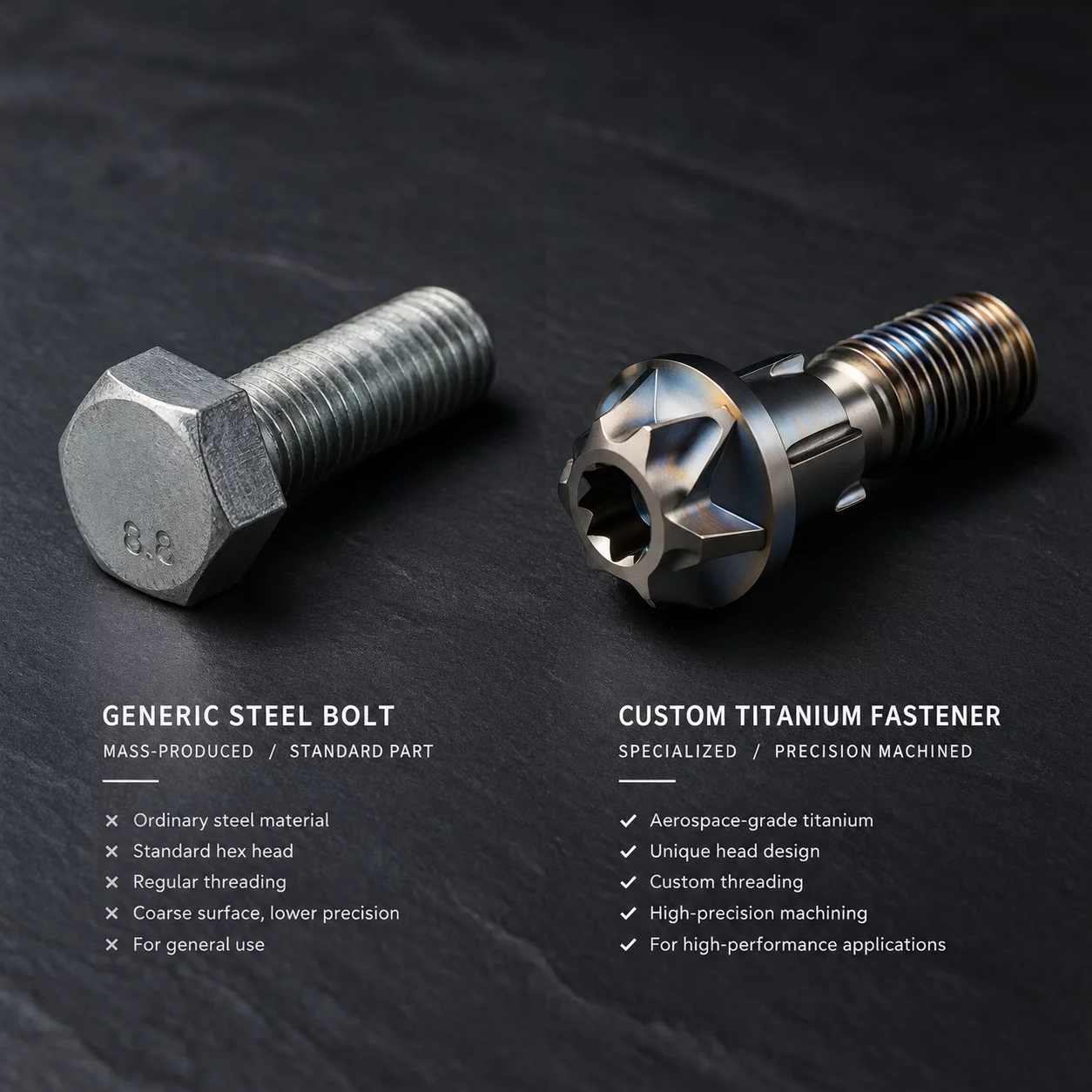
Side-by-side comparison of a standard bolt and a custom-machined fastener.
Fastener Benchmark Summary
Related Case Studies
Optimize Component Architecture
Consult with our mechanical engineering specialists to benchmark catalog standardization against custom tooling for your product lines.
Peer Discussions & Peer Reviews
Join the academic discourse regarding this component analysis.
No comments yet. Be the first to leave a comment.
Leave a Thoughtful Contribution