

Dr. Aris Thorne
Lead Systems Architect •
Structuring a single mechanical baseline to simultaneously satisfy high-cycle industrial automation, marine corrosion resistance, and compact aerospace payload limits.
Divergent Configurations
Core Subassembly Parts
Compliant Verification
Tooling CapEx Saved
Balancing baseline chassis consistency with localized component customization across three target operating environments.
When developing a single product family intended for divergent market sectors, engineering teams often face mutually exclusive operating requirements. In this benchmark analysis of a precision planetary gearbox assembly, the core mechanism needed to satisfy high-throughput manufacturing, continuous saltwater splash zones in marine deck equipment, and strict mass constraints for uncrewed aerospace payloads. Rather than maintaining three disconnected CAD models, our team configured a shared internal carrier architecture paired with specialized external housing geometries and sealing interfaces.
The primary challenge lies in isolating the common load paths from application-specific stress concentrations. By keeping the central sun gear, planetary cluster, and spline shafts completely standardized across all three versions, production teams retain economies of scale in precision gear cutting. Meanwhile, material selections shift strategically between heat-treated 4140 alloy steel, passivated 316L stainless steel, and hard-anodized 7075-T6 aluminum to meet environmental demands without compromising torque density.
Core Shaft Standardization
100% Identical Pitch & Splines
Sealing Tier Divergence
IP54, IP68, and Hermetic
Maximum Thermal Range
-40°C to +125°C Operational
Master Model Management
Unified Parametric Tree
Structuring a single model around three severe requirement envelopes demands deliberate boundary condition definitions during finite element validation. The design team identified key failure modes specific to each variant and resolved them through localized reinforcement rather than global over-engineering:
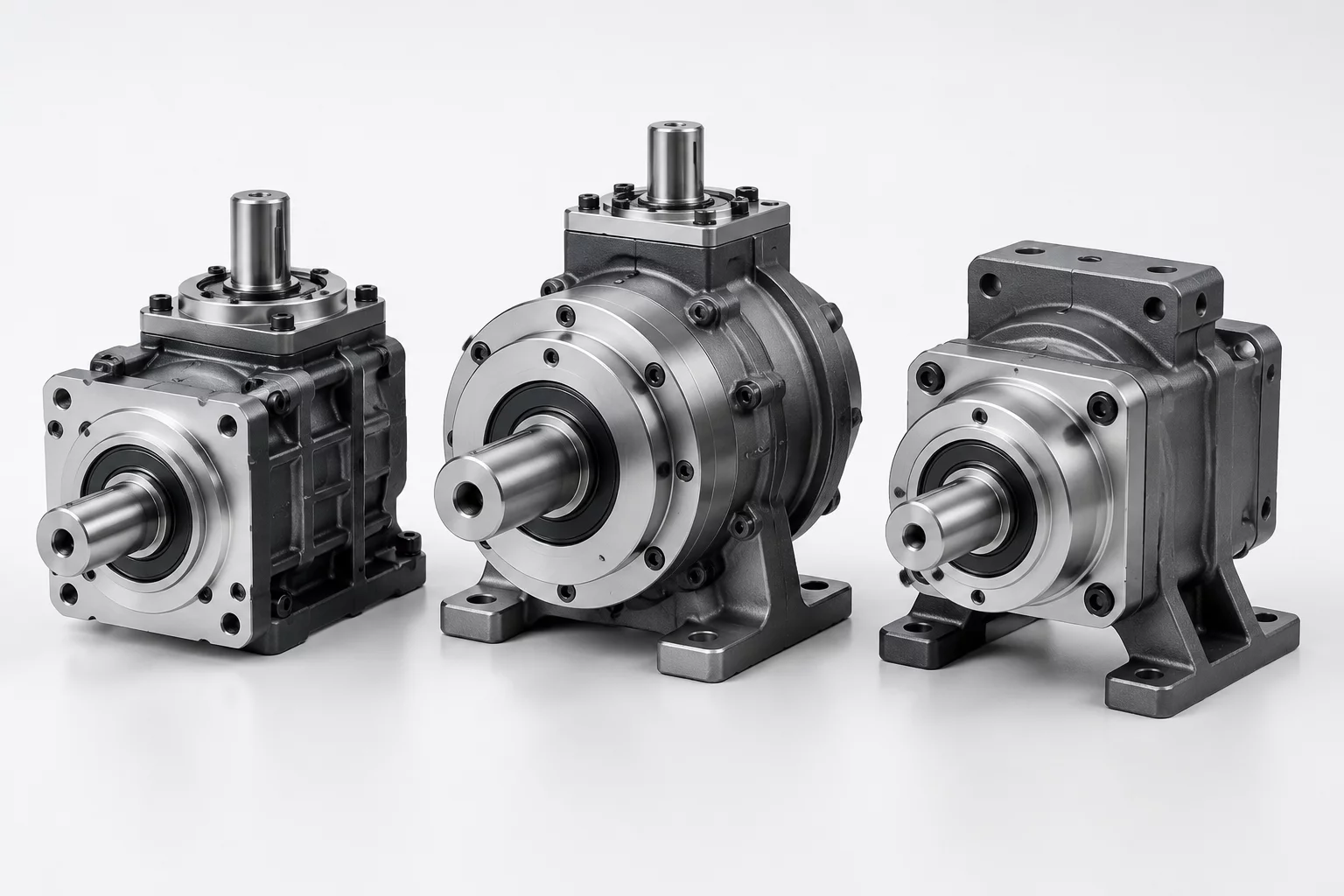
Side-by-side parametric cross-sections showing common central gearset with divergent outer shells and seals.
Review your CAD configurations and subassembly sharing ratios with our principal mechanical engineering team.
Join the academic discourse regarding this component analysis.
Lead Systems Architect •
Author •
Excellent observation, Aris. We resolved dielectric creep by utilizing glass-filled PEEK retaining washers with calibrated shoulder stops. This allows full pre-load torque without crushing the insulating boundary layer during shock transitions.
The decision to maintain a shared spline geometry across both the 7075-T6 and 316L variants is particularly clever. In our own testing of high-torque drivetrains, galvanic isolation at the shaft-housing boundary was our biggest roadblock when deploying lightweight aluminum in proximity to stainless fasteners. How did your team address dielectric gasket compression under dynamic peak loads?