
Part Count Reduction
Variant Generation Speed
Backward Fit Compatibility
Tooling Recoup Cost
Decoupling Monolithic Assemblies for Modular Expansion
Transforming rigid legacy CAD geometry into versatile parametric building blocks while preserving installed base integrity.
Legacy mechanical product lines frequently suffer from brittle, deeply nested feature trees and accumulated custom modifications that resist modernization. Over years of successive releases, minor geometric tweaks create tangled component interdependencies, making it difficult to introduce new functionality without breaking downstream drawings and manufacturing bills of materials. Attempting an unguided total rebuild often introduces unnecessary factory retooling expenses and risks invalidating replacement part supplies for long-standing field installations.
A structured legacy overhaul begins by defining rigid boundary envelopes and explicit interface planes. Design teams extract external mounting datums, shaft centerlines, and electrical passthroughs into isolated skeleton master models. This topological decoupling allows engineers to replace obsolete cast brackets or complex welded housings with modern topology-optimized parts or universal stamped subassemblies, preserving outer mounting points while radically simplifying interior manufacturing operations.
Legacy Modernization Architecture Principles
Datum Standardization
Locked Interface Planes
Assembly Hierarchy
Skeleton Master Modeling
Service Compatibility
Direct Drop-in Replacement
PDM Revision Control
Branch Configuration Trees
Systematic Phasing and Variant Table Integration
Successful modernization executes in structured stages rather than an abrupt cutover. By systematically mapping recurring dimensions across historical variants into centralized design tables, engineering teams isolate core subassemblies from optional attachments. This modular breakdown enables rapid configuration of specialized customer variants while maintaining strict commonality across high-cost baseline components.
- Freezing primary mating datums across all CAD configurations to prevent inadvertent revision drift.
- Replacing disparate custom fasteners and brackets with standardized, multi-hole universal mounting plates.
- Linking driving sketch dimensions to configuration-specific Excel or database tables for automated drawing regeneration.
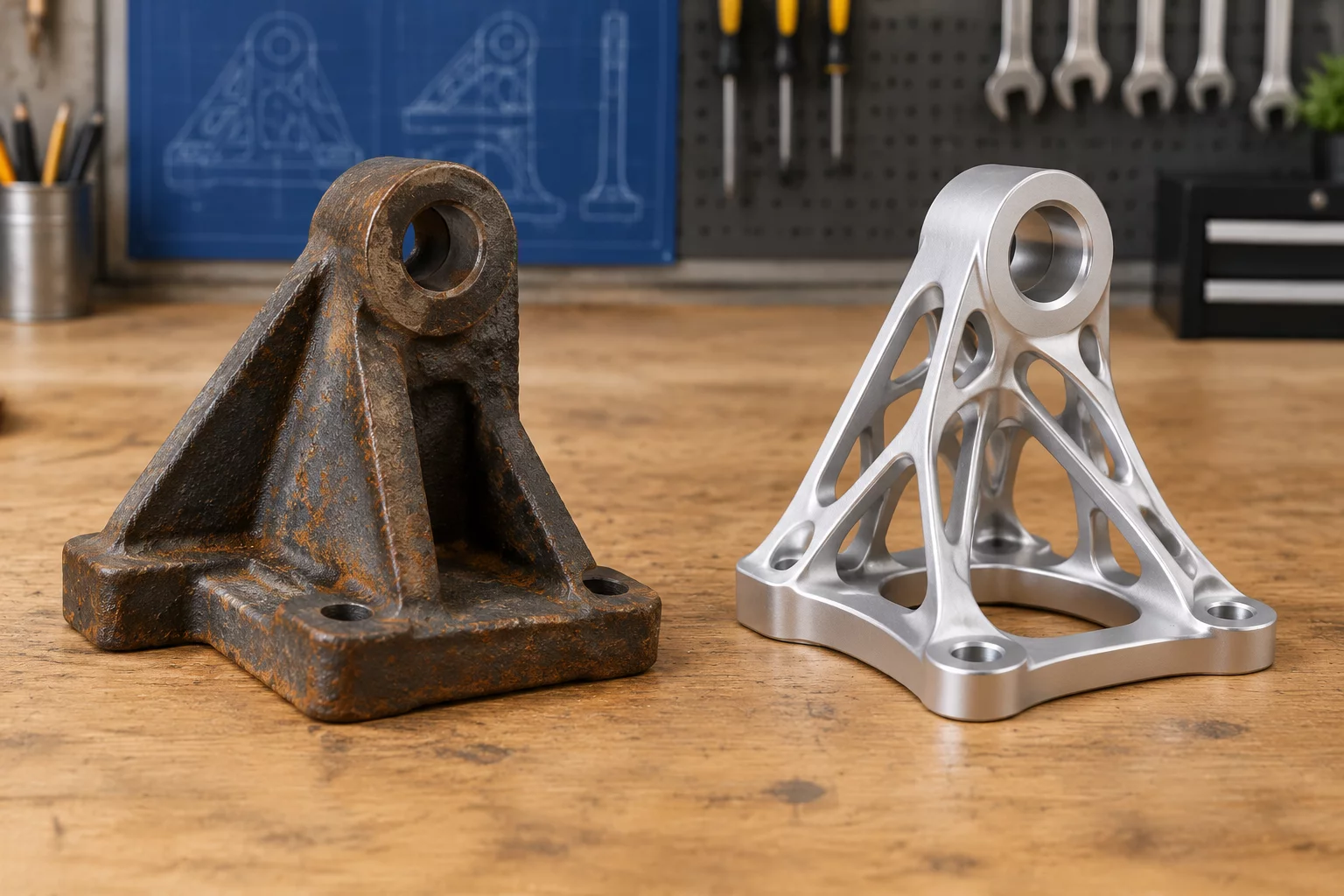
Visual comparison of heavy cast legacy components alongside modern topology-optimized modular replacements.
Modernization Specifications
Related Design Guides
Modernize Your Product Architecture
Consult with our variant architecture team to audit legacy assemblies, construct parametric skeleton layouts, and streamline variant production.
Request Legacy Variant Analysis
Submit your legacy product line specifications for an architectural refactoring and component standardization assessment.
Peer Discussions & Technical Feedback
Join the engineering discussion regarding legacy line modernization and modular architectures.
No peer reviews published yet. Be the first to contribute to this discussion.
Leave a Thoughtful Contribution