
Peak Yield Strength
Max Thermal Rating
Fatigue Limit Benchmark
Weight Reduction Delta
Mechanical Variance & Stress Matrix Analysis
Identifying critical failure modes across diverse industrial operating envelopes
When designing mechanical assemblies for extreme operating regimes, engineers constantly face severe trade-offs between structural rigidity, cyclic fatigue endurance, and overall mass. Selecting the optimal material substrate requires evaluating not only initial tensile yield and elongation limits, but also how microstructural crystalline morphology responds to multiaxial vibration and thermal shock over hundreds of thousands of duty cycles. In high-stress aerospace mounts and downhole subsea manifolds, switching between Ti-6Al-4V Grade 5 titanium, 17-4 PH stainless steel, and carbon-fiber-reinforced polymer matrices radically alters load paths, requiring specific geometric configuration variants in SOLIDWORKS.
A primary challenge in variant management lies in accommodating differing thermal expansion coefficients and notch sensitivity factors across alternative materials. Standardizing bolt patterns and hinge geometries across all product variants often leads to over-engineering the lighter composites or inducing localized stress risers in high-strength alloys. By executing finite element stress topology sweeps across parallel configurations, engineering teams can pinpoint the precise wall thickness thresholds and fillet radii necessary to prevent catastrophic micro-fracture propagation without inflating component weight.
Core Structural Performance Indicators
Density Ratio
4.43 g/cm³ (Ti-6Al-4V)
Young's Modulus
114 GPa Nominal
Thermal Expansion
8.6 μm/m·K
Notch Factor (Kt)
1.12 Stress Index
Critical Engineering Trade-Offs & Configuration Insights
Evaluating high-stress material alternatives reveals distinct manufacturing and longevity compromises that directly govern configuration branching within parametric models:
- Titanium Grade 5 (Ti-6Al-4V): Delivers exceptional strength-to-weight ratios and outstanding corrosion immunity under cyclic loading, yet introduces significant machining cycle time penalties and severe galling susceptibility without proprietary surface nitriding.
- Precipitation Hardened Steel (17-4 PH H900): Provides superior shear tolerance and straightforward machining prior to heat treatment, but imposes a 78% weight penalty over light alloy variants and demands protective coatings in marine atmospheres.
- Continuous Carbon Composite (CFRP UD): Yields unrivaled specific stiffness and directional load optimization along principal stress vectors, though interlaminar shear vulnerability mandates dedicated metal insert bushings at all mechanical fastening interfaces.
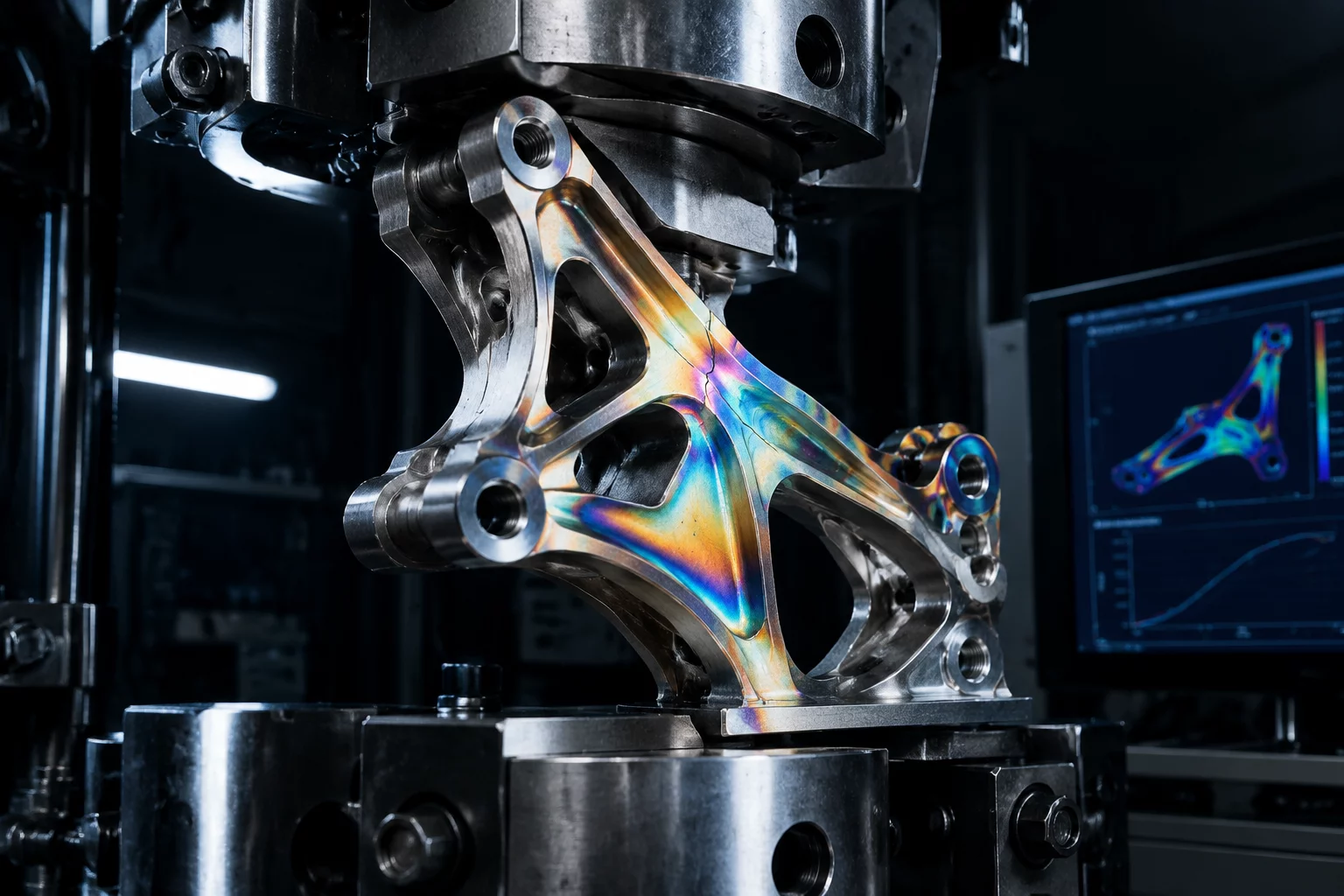
Polarized stress tensor visualization during hydraulic tensile cyclic testing.
Material Comparison Matrix
Related Material Studies
Optimize Material Variants
Need help configuring FEA parametric studies or balancing alloy selection across multi-variant assemblies? Consult our engineering specialists.
Peer Discussions & Peer Reviews
Join the academic discourse regarding this component analysis.
No peer reviews or discussions have been posted yet. Be the first to share your engineering observations.
Leave a Thoughtful Contribution