

Dr. Evelyn Crawford
Lead Systems Architect •
Exploring advanced porous titanium architectures, dynamic fatigue endurance limits, and bioactive surface functionalization for next-generation orthopaedic implants.
Mean Trabecular Porosity
Compressive Yield Strength
Biocompatibility Standard
Dynamic Fatigue Endurance
Detailed assessment of selective laser melting (SLM) alloy variants for orthopaedic load-bearing implants.
At ICM 2026, technical sessions on functional biomaterials centered heavily on overcoming the elastic modulus mismatch between cortical bone and traditional metallic implants. Additive manufacturing through electron beam melting (EBM) and selective laser melting (SLM) enables precisely tuned trabecular lattice networks within Ti-6Al-4V ELI and Ti-Nb-Zr alloys. By configuring diamond and gyroid unit cells with 65–75% controlled porosity, researchers demonstrated effective modulus reduction from 110 GPa down to 18–25 GPa, matching native human bone closely to alleviate stress shielding.
Surface functionalization has advanced beyond inert passivation. Emerging studies showcase osteoinductive calcium-phosphate atomic layer coatings alongside bioactive strontium-doped glass overlays. These surface modifications significantly accelerate hydroxyapatite nucleation and cell adhesion in physiological simulated body fluid (SBF) environments without compromising base metal fatigue endurance under cyclic loading.
Base Chemistry
Ti-6Al-4V ELI / Ti-24Nb-4Zr-8Sn
Pore Size Gradient
300 to 650 µm Interconnected
Elastic Modulus
21.4 GPa (Engineered Gyroid)
Corrosion Resistance
< 0.002 mm/year in Ringer's Sol.
Designing functional biomaterials requires balancing interconnected void fractions for bone ingrowth against notch sensitivity in additive manufacturing. As presented during the ICM fatigue panels, rough as-printed struts exhibit micro-notches that can degrade high-cycle fatigue life if hot isostatic pressing (HIP) and chemical polishing are omitted. Proper post-processing ensures structural integrity across decades of simulated gait cycles.
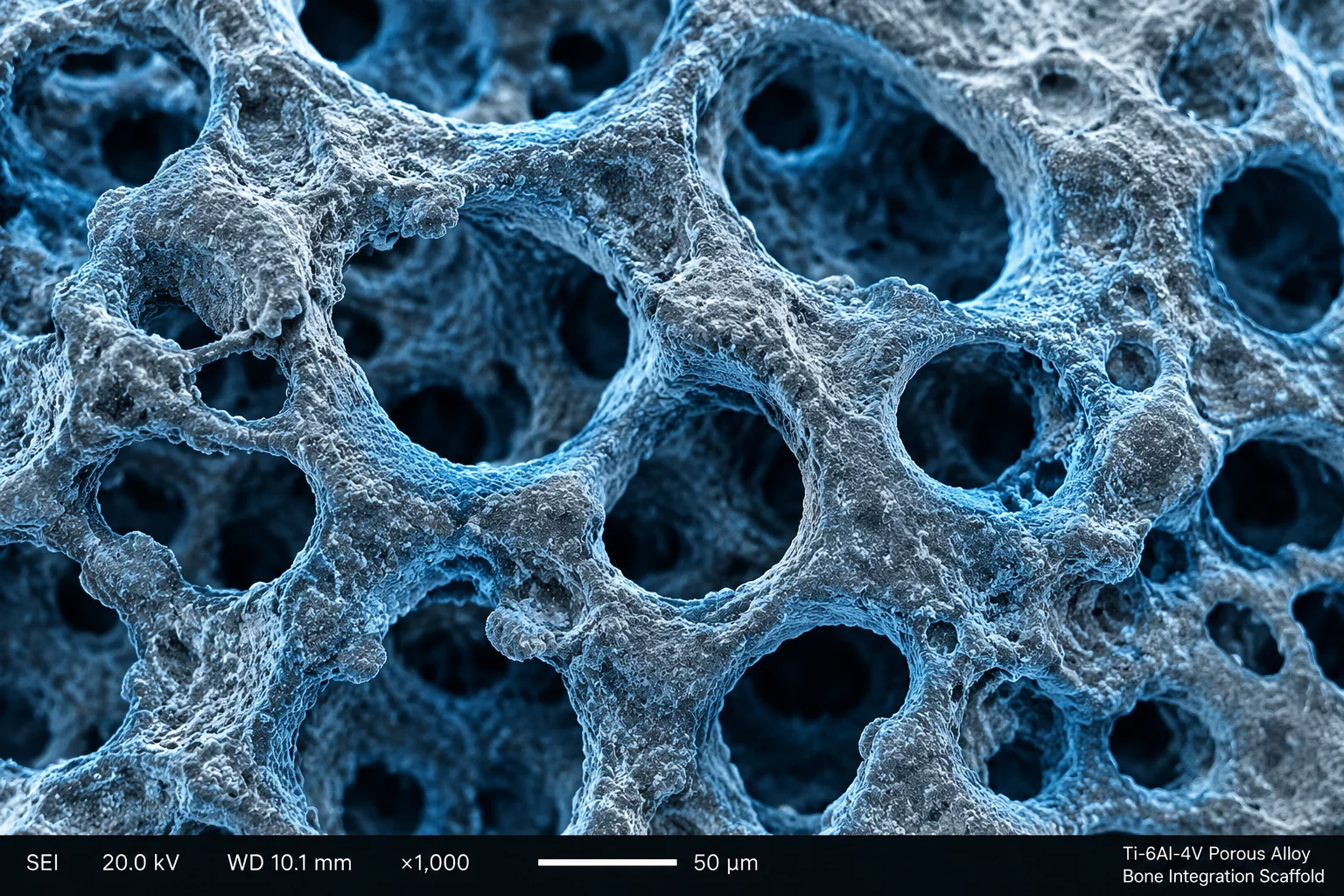
High-magnification micrograph revealing porous titanium lattice structure for enhanced osteointegration.
Consult with our materials engineering specialists on CAD variant architecture, finite element lattice simulations, and biocompatibility verification.
Join the academic discourse regarding this component analysis.
Lead Systems Architect •
Author •
Thank you Dr. Crawford. In our testing, chemical etching reduced wall thickness by approximately 18–25 µm evenly without creating sharp notches, which effectively balanced fluid permeability with predictable fatigue margins.
The correlation between gyroid unit cell orientation and compressive fatigue limits at ICM 2026 was particularly enlightening. Has your group evaluated the impact of chemical polishing on strut cross-section tolerances for intricate sub-300µm pore channels?