
Glass Transition (Tg)
Flexural Modulus
Anisotropic Shrinkage
Max Deposition Rate
Polymer Matrix Compounding and Fiber Dispersion
Optimizing fiber length distribution and interfacial adhesion for bead laydown stability.
Short carbon fiber reinforced high-performance thermoplastics like PESU, PEI, and PPS offer remarkable dimensional stability for large-format extrusion printing. In large-scale additive manufacturing (LSAM), pellet feedstock undergoes continuous single-screw or twin-screw plasticization within high-throughput extruders, depositing large bead profiles at deposition rates exceeding 25 kilograms per hour. Maintaining homogeneous fiber orientation within the compounding phase ensures predictable thermal expansion coefficients across both axial and transverse build axes.
The primary technical hurdle in autoclave-capable tooling revolves around vacuum integrity and thermal cyclic degradation. Standard unreinforced polymers undergo severe sagging and thermal deformation during 180°C cure cycles. By incorporating 20% to 50% chopped carbon fibers into high-glass-transition polyetherimide or polyetherketoneketone formulations, the composite bead achieves near-zero in-plane thermal expansion. This balance minimizes mold warping during post-cure autoclave cycles while preventing internal voids from expanding under sustained positive pressure.
Material Performance Benchmarks
Base Polymer
PEI / PPS / PESU Blends
Fiber Reinforcement
20-50% Chopped CF
Continuous Service Temp
190°C to 230°C
Extrusion Temp Range
340°C - 395°C
Deposition Dynamics and CNC Machining Characteristics
The transition from near-net-shape bead deposition to finished precision tooling requires tailored toolpath planning and subsequent subtractive 5-axis milling. Extruded thermoplastic composite beads exhibit directional porosity along inter-layer weld boundaries, necessitating controlled thermal management during the build process to maximize inter-bead diffusion and structural consolidation:
- Near-Isotropic Thermal Expansion: Fiber alignment along the bead deposition path lowers CTE in the print direction, requiring compensation algorithms during slicing.
- Subtractive Tooling Tolerances: High diamond-coated carbide tooling resistance enables high-speed milling down to ±0.127 mm surface profile tolerance.
- Autoclave Vacuum Hermeticity: High-temperature polymer sealants penetrate surface micro-porosity to maintain vacuum integrity under 7 bar autoclave pressures.
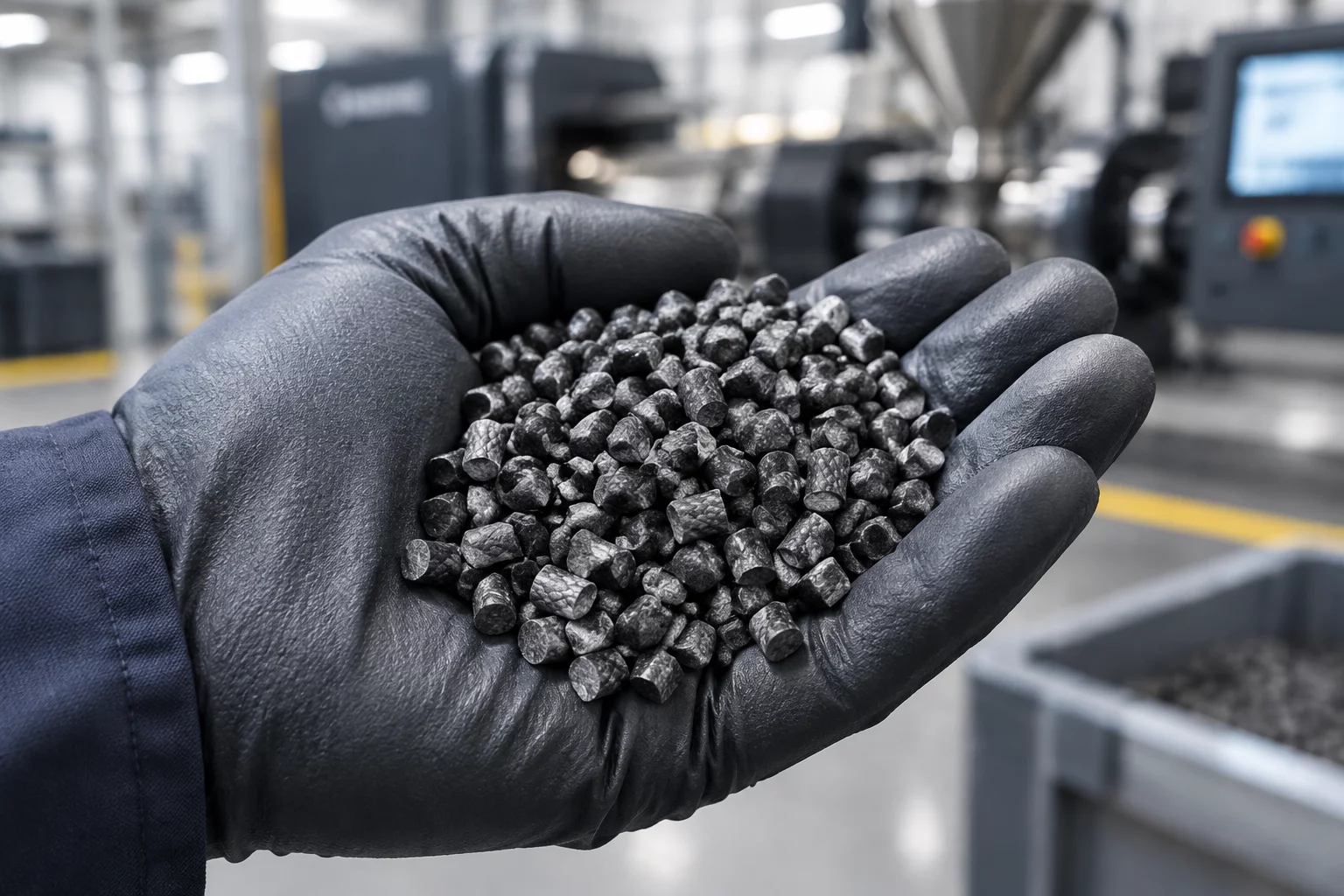
Pellet compounding optimized with 30% short carbon fibers for minimal anisotropic shrinkage during large-format extrusion.
Rheological & Physical Specs
Related Material Analyses
Have questions about LSAM pellet processing?
Connect with our composite material specialists to review CAD model shrinkage coefficients, extruder wear parameters, and high-temperature autoclave qualification.
Peer Discussions & Peer Reviews
Join the academic discourse regarding this component analysis.
No comments yet. Be the first to leave a comment.
Leave a Thoughtful Contribution