Tensile Strength
Service Temperature
Specific Density
Fiber Volume Fraction
Matrix Formulation and Continuous Filament Architecture
Structural synergy across high-temperature aromatic polymers and braided carbon bundles.
During National Composites Week, material engineers demonstrated the practical advantages of coupling polyetheretherketone (PEEK) and polyphenylene sulfide (PPS) matrices with continuous intermediate-modulus carbon tows. The primary engineering challenge has historically centered around interface adhesion between non-polar thermoplastic chains and sized carbon strands. New reactive sizing chemistries highlighted at the symposium create covalent bridges during rapid consolidation cycles, drastically cutting micro-void formation under cyclic shear.
Processing windows demand exact thermal governance to prevent thermal degradation while ensuring complete matrix wetting across dense multidirectional weaves. Automated fiber placement (AFP) heads fitted with high-frequency infrared heaters allow in-situ consolidation at speeds exceeding 15 meters per minute. This throughput rate unlocks structural composite viability for mid-volume industrial brackets and lightweight robotic linkages previously restricted to machined aerospace alloys.
Consolidation & Interface Metrics
Consolidation Pressure
1.2 to 1.8 MPa
Crystallinity Index
32% - 35% Matrix Phase
Interlaminar Shear
86.4 MPa (ASTM D2344)
Thermal Cycle Window
380°C Melt / 180°C Tool
Industrial Application and Parametric Design Constraints
Implementing these composite architectures within parametric CAD environments requires multi-scale modeling routines that account for anisotropic modulus distribution along localized fiber orientations. Standard isotropic FEA assumptions fail near sharp radii or fastener penetrations, making fiber orientation mapping essential for accurate stress prediction.
- Directional stiffness tailoring reduces peak stresses around mechanical fasteners by up to 42% compared to quasi-isotropic layups.
- Thermoplastic matrix re-melting capability enables localized induction welding, eliminating secondary adhesive curing cycles and mechanical rivets.
- Superior fracture toughness and moisture barrier properties prevent microcracking in humid and aggressive chemical operating environments.
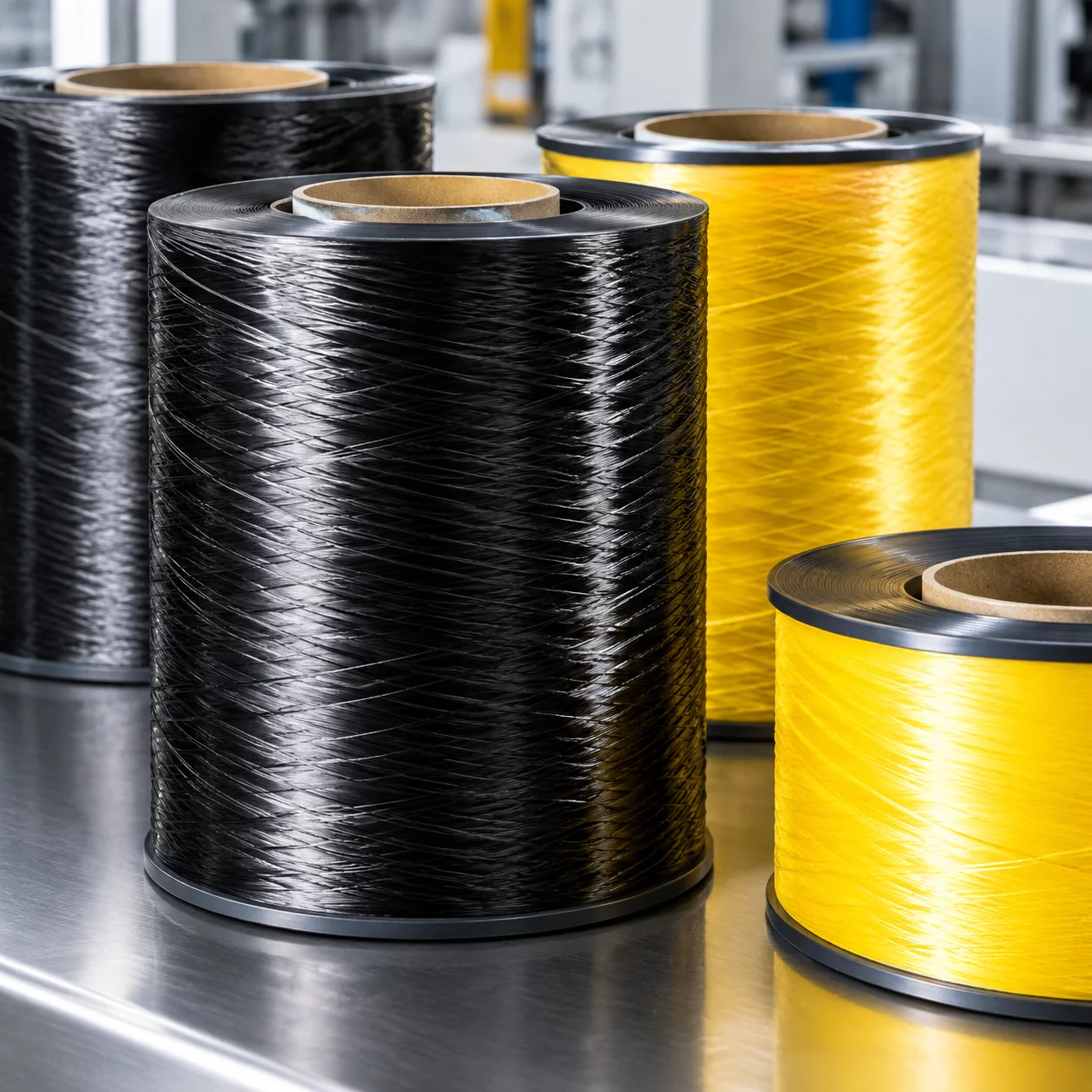
Continuous synthetic fiber tows wound for automated robotic placement systems.
Material & Process Specs
Related Material Reviews
Parametric Composite Consulting
Optimize fiber orientation vectors and matrix selection for your structural mechanical assemblies.
Peer Discussions & Peer Reviews
Join the academic discourse regarding this component analysis.
Leave a Thoughtful Contribution